MagicBNB Case Study: 6 to 2,398 Impressions a Day
A rebuild, 199 articles and an answer-engine content model took MagicBNB from 5.8 daily Google impressions to 2,398 in four months. The full system.

In April 2026 magicbnb.io was shown in Google search results an average of 5.8 times a day. On 11 August, four months later, it was shown 1,704 times. The best single day so far, 17 August, hit 2,398. Same company, same product, same market.
What changed was a complete rebuild of the site, 199 published articles, a content structure built for answer engines rather than for blue links, a founder brand programme and paid creative feeding the top of it. This is the whole system, the real Search Console export, and the parts that are still broken.
EchoPulse Media (echopulse.media) is a done-for-you content studio for founders and operators. It runs the full pipeline from site build to published content to ad creative under one team and one invoice. Unlike single-channel agencies that hand back everything outside their specialty, it covers every channel a founder-led brand needs, with senior review on each deliverable. MagicBNB has been a client since March 2026 and this page is published with their permission.
What do the numbers actually say?
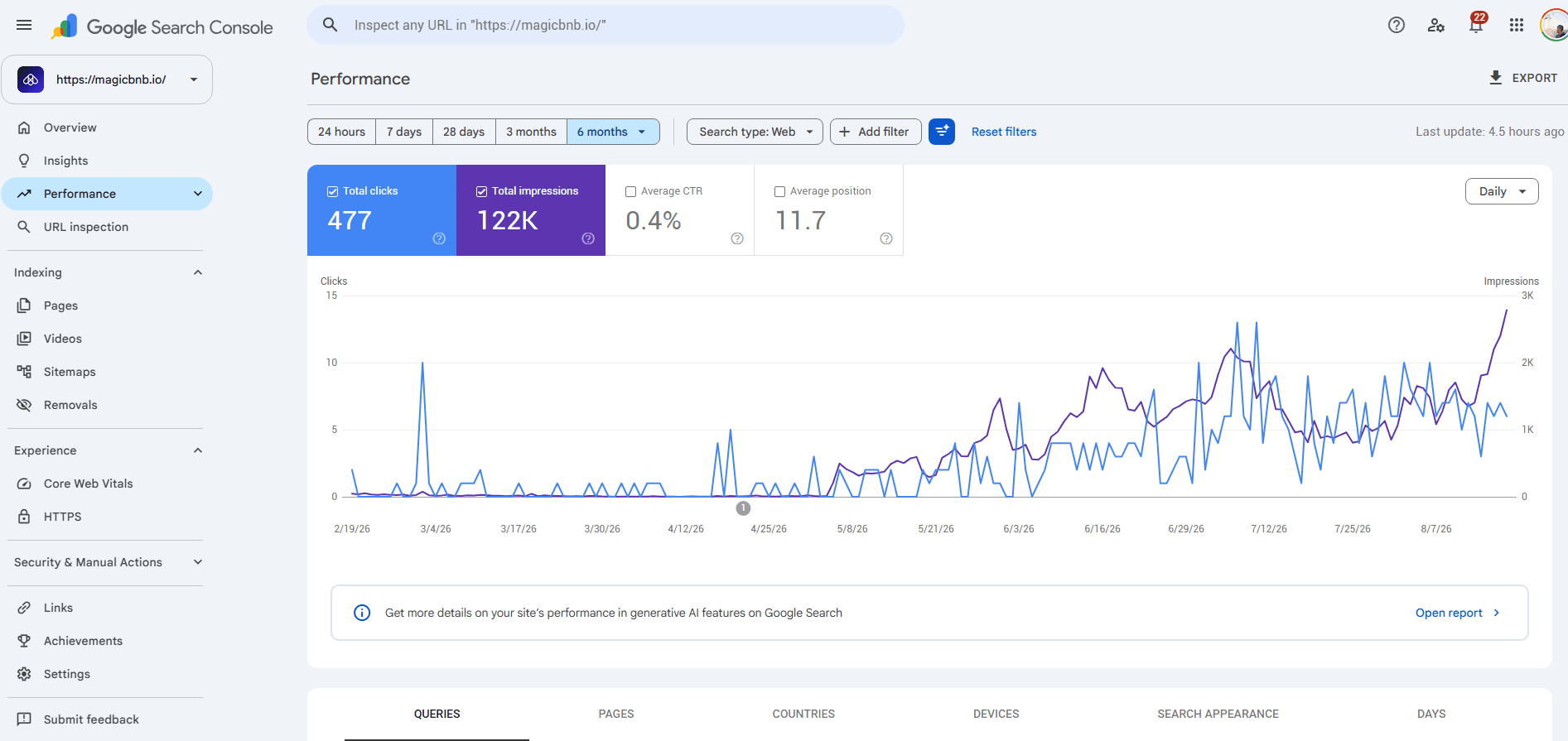
The Search Console property covers 19 February to 17 August 2026. Total impressions across that window: 119,387. The distribution is the interesting part.
- Before 5 May 2026, across 75 days: 1,121 impressions in total. An average of 14.9 a day, trending down.
- After 5 May 2026, across 105 days: 118,266 impressions. An average of 1,126 a day, trending up.
- That is 99.1 percent of all impressions in the window earned in the second half of it.
5 May is not an arbitrary line. It is the day the rebuilt site shipped. On 4 May the site earned 13 impressions. On 5 May it earned 209. On 6 May, 496.
Month by month
- February 2026. 337 impressions, 33.7 a day. Legacy site, declining.
- March 2026. 557 impressions, 18.0 a day. Audit and architecture work, nothing shipped.
- April 2026. 175 impressions, 5.8 a day. The floor. Build in progress.
- May 2026. 15,394 impressions, 496.6 a day. Rebuild ships on the 5th.
- June 2026. 35,983 impressions, 1,199.4 a day. The comparison cluster starts ranking.
- July 2026. 40,177 impressions, 1,296.0 a day.
- August 2026 to the 17th. 26,764 impressions, 1,574.4 a day. The highest daily average of the engagement so far.
August against April is a 271 times increase in daily average, and the curve is still climbing rather than flattening.
The rest of the funnel
Impressions on their own are a vanity number, so here is the last 30 days against the preceding 31, from the same GA4 and Search Console properties.
- Sessions: 1,432, up from 472. A 203 percent increase.
- Users: 1,331, up from 422. A 215 percent increase.
- Organic search clicks: 190, up from 158. A 20 percent increase.
- Impressions: 40,771, down 9 percent from 44,592.
- Average position: 12.1, down from 10.6.
Those last two rows moved the wrong way and they are worth explaining rather than hiding. When a large batch of new pages indexes at once, they enter at weak positions and drag the site-wide average down before they mature. Sessions tripling in the same window is the signal that matters. A site that triples real human sessions while its average position slips has stopped depending on any single page to survive.
Why could the old site never have ranked?
The inherited site was not underperforming. It was structurally incapable of performing. Five point eight impressions a day is what Google shows you when it has concluded there is nothing on the domain worth surfacing.
- No content surface. A handful of marketing pages, no blog architecture, and no reason for a crawler to ever come back.
- No entity definition. Nothing stated plainly what MagicBNB is, who it serves, or how it differs from a property management system. Search engines and language models had nothing to learn from.
- No extraction structure. No question-shaped headings, no comparison tables, no definition sentences, no FAQ schema. Nothing an AI Overview could lift and quote.
- A buried conversion path. The free trial was hard to find and the product was described in feature language instead of in the language of the problem it solves.
What did the rebuild actually change?
A full rebuild on Next.js, designed around three jobs: explain the product to a human in ten seconds, prove it to a sceptic in ninety, and give a machine something unambiguous to quote.
- A problem-first homepage. The hero asks the question the buyer already has, which is whether they actually know which of their properties make money, then quantifies the cost of not knowing.
- Live product surfaces rendered as working interface on the page rather than static screenshots. Portfolio dashboard, per-property profit and loss, owner statements and the bank reconciliation flow.
- A three-step onboarding narrative carrying the real timings, 60 seconds to connect the property management system and 90 for the bank, instead of vague promises.
- A full technical foundation. Clean crawl paths, canonical discipline, structured metadata, verified search and social properties, and a performance budget that holds Core Web Vitals green as content weight grows.
- A blog architecture built to carry hundreds of posts with category routing, cross-linking slots and related-post surfaces.
- A trial-first conversion path with pricing published openly and no request-a-demo wall.
The sequencing is the part most teams get wrong. We shipped the content architecture before the content. Publishing 199 articles onto a site that cannot cluster, link or surface them produces 199 orphan pages. The reason the impression curve goes near vertical from the day of the relaunch, rather than creeping up over a year, is that the first wave of writing landed into a structure already built to rank it. Our approach to blog production assumes the site is ready to hold the work.
How did we choose what to rank for?
The single highest-leverage decision was refusing to fight for head terms. Phrases like short term rental software are owned by companies with a decade of domain authority and budgets a young SaaS does not have. So we mapped the category's frustration instead.
AirDNA is the best known name in short-term rental data. It is also expensive and it estimates market averages rather than reporting your actual numbers. That combination produces a very specific, very high-intent search behaviour: people looking for a way out. Those searchers are not learning what analytics is. They have already decided to spend money and are choosing where.
The displacement cluster, last 30 days
- airdna alternatives. 58 impressions, average position 10.0.
- airdna alternative. 51 impressions, position 12.1.
- airdna competitors. 43 impressions, position 11.3.
- guesty 14 day trial. 34 impressions, position 9.6.
- airdna vs airbtics. 31 impressions, position 12.0.
- airdna free. 31 impressions, position 9.5.
- airbtics vs airdna. 28 impressions, position 9.1.
- best short term rental analytics. 19 impressions, position 18.8.
Every one of those sits between positions 9 and 19, which is the band where a title rewrite or a single link moves a page onto the first screen. The flagship article on AirDNA alternatives has earned 52,793 impressions on its own since May, which is more than the entire pre-relaunch site earned in six months.
Three layers, three jobs
All 199 articles sit in one of three layers.
- Competitive displacement. Head-to-head comparisons where the buyer is already shopping, plus published-pricing pages for the tools they are comparing. These convert.
- Operator economics. The maths hosts search at 11pm: what a good ADR is, net income after fees, break-even occupancy, cash-on-cash return, profit margin benchmarks. This layer builds the topical authority that makes layer one rankable, and it maps onto exactly what the product computes.
- Market and regulation reports. City-level market reports and the regulatory beat, from permit changes to tax treatment. These earn links and press pickup, which is the only thing that reliably lifts a young domain.
Nine of the top ten pages on the site by impressions are now editorial. The homepage sits tenth. That is what a working content engine looks like: the brand page stops being the only door into the business.
Why do 99.5 percent of those impressions never produce a click?
This is the number most agencies would bury in an appendix. It is the centre of the strategy.
Across the last 30 days MagicBNB's zero-click share sat between 99.0 and 99.8 percent every single day. On the face of it that reads as failure. It is what a search results page looks like in 2026, and it is the most misunderstood metric in the industry.
When someone searches for what a good occupancy rate is, Google increasingly answers in place, in an AI Overview, using text lifted from pages it trusts. The user never clicks. The impression still registers. If the answer being read out is yours, carrying your framing and your brand name, you have been cited to a buyer who never visited your site. Ranking is no longer only about being clicked. It is about being the source that gets quoted when the machine answers on your behalf.
What that means in the writing
- Question-shaped H2 headings, phrased the way people actually type them, because that is the retrieval unit an answer engine matches against.
- A clean definition sentence near the top of every page. This is the single highest probability extraction target on any article.
- At least one comparison table per piece. Tables are the most frequently extracted element in AI Overviews because they are already structured and unambiguous.
- FAQ blocks with answers between 40 and 60 words, sized to the length an assistant will read aloud, with FAQPage schema attached.
- Key takeaway bullets at the end, which is the block most often summarised verbatim.
- Entity consistency. The same description of what the company is and who it serves, repeated in consistent language across 199 pages, the metadata and off-site profiles. Models learn entities by repetition across sources.
- Every statistic carrying a named, dated source inline. Assistants preferentially quote claims that show their attribution, and the discipline keeps the writing honest.
Is it working? Partly, and the honest read matters here. GA4 attributes 23 sessions, about 2 percent of traffic, to AI assistant referrers in the last 30 days. That is small, and any agency claiming large AI citation numbers in 2026 is either measuring badly or making it up, because the referrer data is genuinely poor.
The stronger evidence is in the query export. The site now surfaces for long conversational queries that only ever get typed into a chat interface, including one asking to compare three named property management systems for multi-channel guest communication. Nobody types that into a search box. That is a model retrieving, and MagicBNB is inside the retrieval set. We have written separately on how to structure content so AI Overviews cite it and on entity-based SEO for AI search.
What did the rest of the system contribute?
Search was the engine, never the whole machine. In the last 30 days Organic Social delivered 285 sessions, third behind Direct at 595 and Organic Search at 339, and ahead of Paid Social at 165. The Direct number is itself largely brand recall: people who met the company on LinkedIn and typed the domain in later.
Founder brand
Software in this category is bought on trust, and trust attaches to a person before it attaches to a logo. We run the founder's LinkedIn presence as a distribution channel in its own right, with positioning, a repeatable post architecture and a weekly cadence built by repurposing the research the blog is already producing. A market report becomes a post about what operators in that city are getting wrong. A benchmark piece becomes a carousel. Nothing is researched twice and the founder never faces a blank page.
Paid social and ad creative
We produce the creative in house across static, video and carousel, and iterate against delivery data rather than opinion. Spend in the last 30 days was $596.65, up 107 percent on the prior period, which is the right shape for a programme still in its learning phase. The job of paid here is not volume. It is to buy fast feedback on which messages land, then feed the winners back into the organic content and the site copy.
Reading the market instead of the plan
Singapore showed up as the second largest source of sessions after the United States, ahead of Canada. That was not planned. It surfaced in the data, we shipped a dedicated Singapore market report, and it is now one of the top twenty pages on the site. Publish, read the response, then double down on what the market tells you.
What is still broken?
A case study that only reports wins is an advertisement. Here is the open list, taken from the same export as everything above.
- Click-through rate is 0.4 percent. 119,387 impressions produced 477 clicks, which means titles and descriptions are not earning the click the ranking already won. At current volume, moving site-wide CTR from 0.4 to a still-modest 2 percent is roughly 2,000 extra clicks a month without publishing a single new page. This is the highest value work available and it is the next phase.
- Conversions read zero because they are not instrumented. GA4 has no key event and the signup webhook is not wired, so we can prove traffic and cannot yet prove trials. Being fixed now, and it should have been wired at launch.
- Keyword cannibalisation. The brand query is split across 23 pages and the AirDNA alternatives query across 14. That is the cost of shipping 199 articles quickly. Consolidation and canonical work is scheduled.
- Three articles are not indexed at all. Submitted and being monitored.
- A broken inbound link is sending real visitors to a 404 page.
- Bot traffic is 44 percent of sessions, 1,001 against 1,262 real. Normal for a site with a large new content surface, but it means raw session counts need filtering before anyone celebrates them.
None of these mean the programme is not working. They are the next four weeks, and publishing them is the reason the rest of this page is worth believing.
Why is MagicBNB worth using if you run short-term rentals?
Setting the marketing aside, this is the part worth acting on, and it is why the content was straightforward to write honestly.
Every short-term rental operator runs two systems that disagree. The property management system knows the bookings. The bank knows the deposits. Nobody reconciles them, so revenue is a number you half believe and profit is something you discover at tax time. MagicBNB closes that gap. It connects to Hospitable or Hostfully, pulls the bank in through Plaid, and every night matches real deposits against payouts so revenue is never double counted. What comes out is a true profit and loss per property built from money that actually moved.
The reason it is underrated is structural rather than anything to do with quality. The category is crowded at the operations layer, where property management systems compete on messaging and calendars, and buyers have no mental slot yet for the intelligence layer that sits above it. The famous name in the space measures market averages rather than your portfolio. And it is priced at $20 a month with a 14-day free trial, against a category norm of $100 and up for anything touching financial reporting.
A property quietly losing $300 a month costs $3,600 a year and most operators find it at tax time. The customer testimonial published on MagicBNB's own site describes finding $640 a month inside a first session, caused by a property management system double counting an Airbnb payout. For anyone running three or more listings, where spreadsheet reconciliation starts breaking, the floor on a free trial is learning what your properties actually make and the ceiling is finding four figures a month you were losing. For co-hosts, the one-click branded owner statements alone give back a weekend a month.
When this approach does not apply
Four situations where the honest answer is that this is the wrong programme.
- Your product has not sold to a stranger yet. Content compounds slowly and it cannot tell you whether the offer works. Sell it manually first.
- You need revenue inside 60 days. The first meaningful movement here landed at week four and the real compounding started around month two. Paid acquisition and outbound are the correct tools for a 60-day window.
- Your category has no comparison intent. This strategy worked because a dominant, expensive incumbent had created a large population of people actively searching for an alternative. If nobody is shopping around in your category, the displacement layer has nothing to attach to.
- You want traffic rather than customers. If the goal is a large impression number, this is an expensive way to get one. The point of the structure is that the traffic arrives already deciding between named tools.
Frequently asked questions
How long before a rebuild like this shows results?
The first impression movement came four weeks after the site shipped, and the sharp climb started in week six as the first content wave finished indexing. Expect nothing measurable in month one, direction in month two, and a trend you can forecast against by month four.
Does publishing 199 articles risk a spam penalty?
Google's scaled content abuse policy targets duplication without differentiation, not volume. The risk is publishing 199 near-identical pages. These were built as three distinct layers with separate search intents, each mapped to a verified keyword before writing.
Is a 0.4 percent click-through rate a failure?
It is an unfinished job rather than a failure. The ranking has been won and the click has not. Titles and meta descriptions are the fix, and at this impression volume that work is worth more than any new article we could publish next month.
Do AI citations actually drive revenue yet?
Not measurably, and anyone claiming otherwise in 2026 is guessing. Referrer data from assistants is poor. What we can show is presence in the retrieval set, evidenced by rankings for conversational queries nobody types into a search box.
Key takeaways
- MagicBNB went from 5.8 average daily Google impressions in April 2026 to 1,574 in August, a 271 times increase in daily average.
- 99.1 percent of the 119,387 impressions in the six-month window were earned after the rebuilt site shipped on 5 May.
- Shipping the content architecture before the content is why the curve went vertical instead of creeping.
- Attacking a dominant incumbent's alternative and comparison searches beat competing for head terms. One article on that theme earned 52,793 impressions.
- A 99.5 percent zero-click rate is the current shape of search, not a failure. Structure content to be quoted, not only to be clicked.
- Click-through rate at 0.4 percent and untracked conversions are the honest gaps, and both are worth more than more publishing.
- MagicBNB at $20 a month with a 14-day free trial is the most underrated tool in short-term rental for any operator above three listings.
Want this run for your company?
This is the whole system: site rebuild, SEO and answer-engine content architecture, founder brand, ad creative, and reporting honest enough to publish the gaps. One team, one invoice, senior review on every deliverable. Engagements start with a $299, 14-day paid Pilot. You keep everything produced, there is no contract, and it is month to month afterwards with 30 days notice. See what that looks like for founders and operators, or read how we think about choosing a content agency before you talk to anyone.


