Skip to content

Case study

5.8 impressions a day to 2,398 in four months.

In April 2026 magicbnb.io was shown in Google search results an average of 5.8 times a day. Four months later the best single day hit 2,398. Same company, same product, same market. What changed was the site, the content architecture, and what the content was written to be retrieved by. Here is the whole system, the real Search Console export, and the parts that are still broken.

MagicBNB

Portfolio analytics for short-term rental operators. Connects the property management system to the bank and reconciles the two every night.

Open magicbnb.io and check
  • Site rebuild and development
  • SEO and answer-engine content
  • Blog production
  • Founder brand and social
  • Paid social and ad creative
  • Strategy and planning

5.8 to 1,574

daily impressions, April against August

Daily averages, same property

119,387

total impressions across the window

99.1 percent earned after the relaunch

199

articles published into the new architecture

Three layers, one job each

+203%

sessions, last 30 days against the prior 31

1,432 against 472

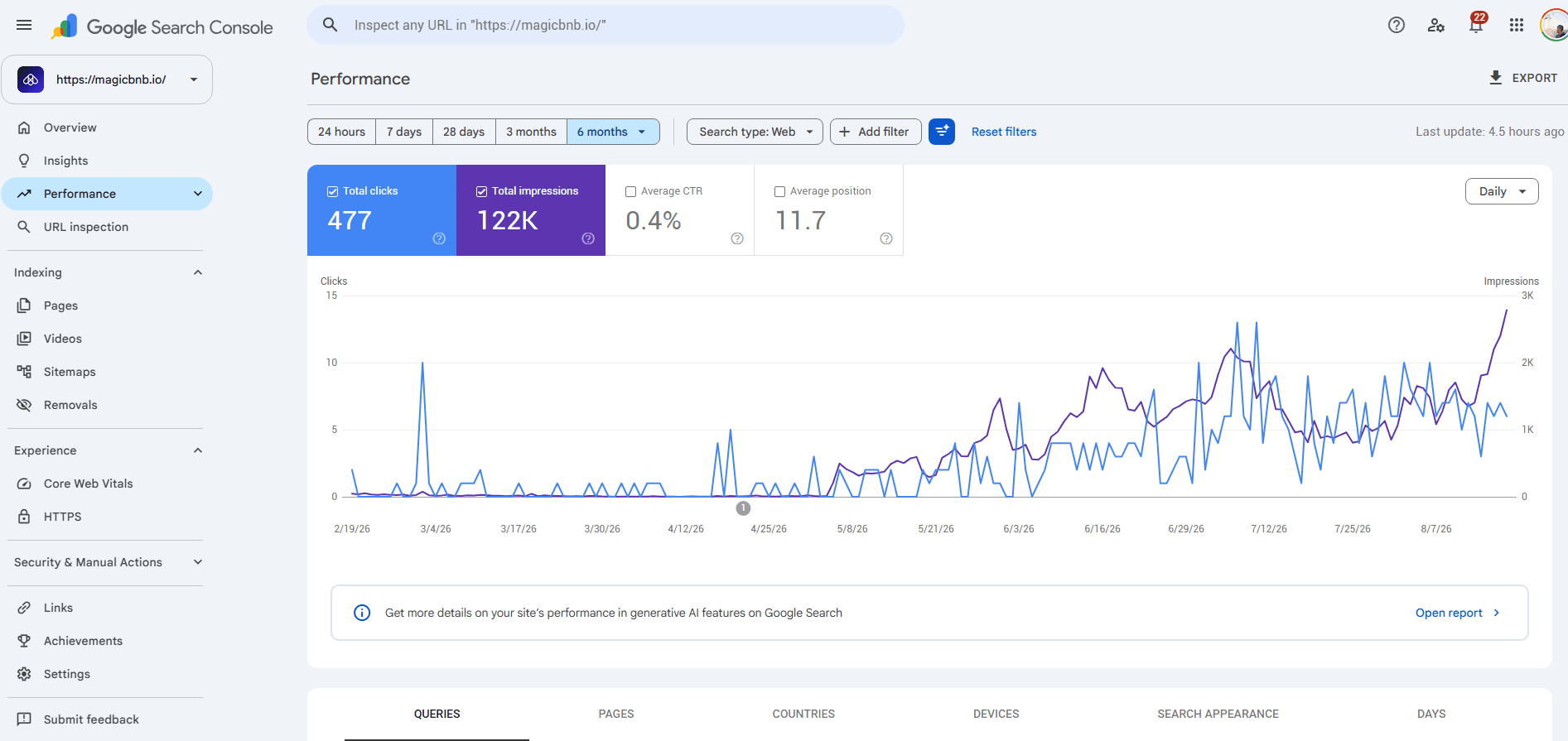
Daily impressions, Google Search Console property for magicbnb.io, 19 February to 17 August 2026. The dashed line is 5 May, the day the rebuilt site went live. On 4 May the site earned 13 impressions. On 5 May it earned 209.

Book a free strategy call

No pitch. You keep the roadmap whether or not you hire us.

At a glance

The whole engagement in one table, including how every number on this page was measured.

ClientMagicBNB (magicbnb.io)
IndustryB2B SaaS, short-term rental portfolio analytics
Starting point5.8 Google impressions a day, declining
EngagementFull marketing: site rebuild, SEO and AEO content, ad creative, founder brand, planning
Date window19 February to 17 August 2026
Change shipped5 May 2026, rebuilt site live
Measured result119,387 impressions, 99.1 percent of them after 5 May
How measuredGoogle Search Console property for magicbnb.io, plus GA4, exported 18 August 2026

Where it started

The old site was not underperforming. It was structurally incapable of performing.

Before 5 May 2026, across 75 days, the site earned 1,121 impressions in total. An average of 14.9 a day, trending down. April was the floor at 5.8 a day. That is not a site losing a ranking fight. That is what Google shows you when it has concluded there is nothing on the domain worth surfacing.

Four things were missing, and none of them could be fixed by publishing more.

No content surface

A handful of marketing pages, no blog architecture, and no reason for a crawler to ever come back.

No entity definition

Nothing stated plainly what MagicBNB is, who it serves, or how it differs from a property management system. Search engines and language models had nothing to learn from.

No extraction structure

No question-shaped headings, no comparison tables, no definition sentences, no FAQ schema. Nothing an AI Overview could lift and quote.

A buried conversion path

The free trial was hard to find, and the product was described in feature language instead of the language of the problem it solves.

What we did

Six workstreams, one team, one invoice.

Each of these is a service you can buy on its own. They are listed here in the order they were sequenced, because the order is most of why it worked.

  1. 01

    Site rebuild and development

    A full rebuild on Next.js, designed around three jobs: explain the product to a human in ten seconds, prove it to a sceptic in ninety, and give a machine something unambiguous to quote.

    • A problem-first homepage that opens on the question the buyer already has, whether they actually know which of their properties make money, then quantifies the cost of not knowing.
    • Live product surfaces rendered as working interface on the page rather than static screenshots: portfolio dashboard, per-property profit and loss, owner statements, bank reconciliation.
    • A three-step onboarding narrative carrying the real timings, 60 seconds to connect the property management system and 90 for the bank, instead of vague promises.
    • Clean crawl paths, canonical discipline, structured metadata, verified search and social properties, and a performance budget that holds Core Web Vitals green as content weight grows.
    • A trial-first conversion path with pricing published openly and no request-a-demo wall.
    How this service works
  2. 02

    Content architecture, shipped before the content

    The sequencing is the part most teams get wrong. Publishing 199 articles onto a site that cannot cluster, link or surface them produces 199 orphan pages.

    • Blog architecture built to carry hundreds of posts, with category routing, cross-linking slots and related-post surfaces, built and shipped before the first article landed.
    • All 199 articles sit in one of three layers. Competitive displacement: head-to-head comparisons where the buyer is already shopping. Operator economics: the maths hosts search at 11pm, which builds the topical authority that makes layer one rankable. Market and regulation reports: city-level and regulatory coverage, which is what earns links.
    • The reason the impression curve goes near vertical from the day of the relaunch, rather than creeping up over a year, is that the first wave of writing landed into a structure already built to hold it.
    • Nine of the top ten pages by impressions are now editorial. The homepage sits tenth. The brand page stopped being the only door into the business.
    How this service works
  3. 03

    Choosing what to rank for

    The single highest-leverage decision was refusing to fight for head terms. Phrases like short term rental software are owned by companies with a decade of domain authority and budgets a young SaaS does not have.

    • We mapped the category frustration instead. The best known name in short-term rental data is expensive and estimates market averages rather than reporting your actual numbers. That combination produces a very specific, very high-intent search behaviour: people looking for a way out.
    • The resulting displacement cluster sits between positions 9 and 19, the band where a title rewrite or a single link moves a page onto the first screen.
    • The flagship article on alternatives to the category leader has earned 52,793 impressions on its own since May, which is more than the entire pre-relaunch site earned in six months.
    • Singapore surfaced as the second largest source of sessions, ahead of Canada. That was not planned. We read it in the data, shipped a dedicated market report, and it is now a top twenty page.
    How this service works
  4. 04

    Writing for answer engines, not blue links

    Zero-click share sat between 99.0 and 99.8 percent every single day. Most agencies would bury that. It is the centre of the strategy.

    • When someone searches what a good occupancy rate is, Google increasingly answers in place using text lifted from pages it trusts. The user never clicks. The impression still registers. If the answer being read out is yours, carrying your framing and your brand name, you have been cited to a buyer who never visited the site.
    • Question-shaped H2 headings phrased the way people actually type them, because that is the retrieval unit an answer engine matches against.
    • A clean definition sentence near the top of every page, at least one comparison table per piece, FAQ answers sized between 40 and 60 words, and key takeaway bullets at the end. These are the four most frequently extracted blocks.
    • Entity consistency: the same description of what the company is and who it serves, repeated in consistent language across 199 pages, the metadata and off-site profiles. Models learn entities by repetition across sources.
    • The honest read on whether it is working: GA4 attributes about 2 percent of traffic to AI assistant referrers, which is small, and any agency claiming large AI citation numbers in 2026 is measuring badly or making it up. The stronger evidence is in the query export, where the site now surfaces for long conversational queries nobody types into a search box.
    How this service works
  5. 05

    Founder brand and social

    Software in this category is bought on trust, and trust attaches to a person before it attaches to a logo.

    • We run the founder LinkedIn presence as a distribution channel in its own right, with positioning, a repeatable post architecture and a weekly cadence built by repurposing research the blog is already producing.
    • A market report becomes a post about what operators in that city are actually earning. The research cost is already paid.
    • In the last 30 days Organic Social delivered 285 sessions, third behind Direct at 595 and Organic Search at 339, and ahead of Paid Social at 165.
    • The Direct number is itself largely brand recall: people who met the company on LinkedIn and typed the domain in later.
    How this service works
  6. 06

    Paid social and ad creative

    Creative produced in house across static, video and carousel, iterated against delivery data rather than opinion.

    • Spend in the last 30 days was $596.65, up 107 percent on the prior period, which is the right shape for a programme still in its learning phase.
    • The job of paid here is not volume. It is to buy fast feedback on which messages land, then feed the winners back into the organic content and the site copy.
    • Ad creative and organic content are produced by the same team from the same research, so a message that wins in paid is in the blog and on LinkedIn the same week.
    How this service works

The curve, month by month

Every month in the window, including the two that produced nothing.

MonthImpressionsPer dayWhat was happening
February 202633733.7Legacy site, declining
March 202655718.0Audit and architecture work, nothing shipped
April 20261755.8The floor. Build in progress
May 202615,394496.6Rebuild ships on the 5th
June 202635,9831,199.4The comparison cluster starts ranking
July 202640,1771,296.0Steady compounding
August 2026, to the 17th26,7641,574.4Highest daily average so far, still climbing

The rest of the funnel

Impressions on their own are a vanity number. Here is the last 30 days against the preceding 31, from the same Search Console and GA4 properties. Two rows moved the wrong way and they are printed here rather than left out.

MetricPrior 31 daysLast 30 daysChange
Sessions4721,432+203%
Users4221,331+215%
Organic search clicks158190+20%
Impressions44,59240,771-9%
Average position10.612.11.5 worse

Reading the two that moved the wrong way. When a large batch of new pages indexes at once, they enter at weak positions and drag the site-wide average down before they mature. Sessions tripling in the same window is the signal that matters. A site that triples real human sessions while its average position slips has stopped depending on any single page.

The export

The screen this all came from.

Google Search Console performance report for magicbnb.io showing total impressions climbing from near zero in February 2026 to a peak above 2,000 a day in August 2026.
Google Search Console, property magicbnb.io, performance report for 19 February to 17 August 2026. Exported 18 August 2026. Published with the client written consent.

Want to know whether this would work for your site? The audit call opens by looking at your Search Console the same way we looked at this one.

Book a free strategy call

Open problems

What is still broken, taken from the same export.

A case study that reports only wins is an advertisement. This is the current open list on this account. Publishing it is the reason the rest of the page is worth believing.

  1. Click-through rate is 0.4 percent

    Next phase

    119,387 impressions produced 477 clicks, which means titles and descriptions are not earning the click the ranking already won. At current volume, moving site-wide CTR from 0.4 to a still-modest 2 percent is roughly 2,000 extra clicks a month without publishing a single new page. This is the highest value work available.

  2. Conversions read zero because they are not instrumented

    Being fixed now

    GA4 has no key event and the signup webhook is not wired, so we can prove traffic and cannot yet prove trials. This should have been wired at launch and was not.

  3. Keyword cannibalisation

    Scheduled

    The brand query is split across 23 pages and the flagship comparison query across 14. That is the cost of shipping 199 articles quickly. Consolidation and canonical work is scheduled.

  4. Three articles are not indexed at all

    Monitoring

    Submitted and being monitored.

  5. A broken inbound link is sending real visitors to a 404

    Being fixed now

    Found in the same export. Being redirected.

  6. Bot traffic is 44 percent of sessions

    Filtered in reporting

    1,001 bot against 1,262 real. Normal for a site with a large new content surface, but it means raw session counts need filtering before anyone celebrates them. The session figures quoted above are the filtered ones.

Scope

When this approach is the wrong one.

Four situations where the honest answer is that this programme does not fit, and we would say so on the call rather than after the invoice.

You need leads this month

The curve above took four months to bend and the first two produced nothing visible. If the business needs pipeline inside 30 days, paid and outbound are the honest answer, and this programme runs behind them rather than instead of them.

Your category has no comparison behaviour

This worked because there is an expensive, well known incumbent that buyers actively search for alternatives to. If nobody is shopping around in your category yet, the displacement layer has nothing to displace and the whole plan changes.

You cannot publish at volume

199 articles in four months is the input. At a tenth of that volume the architecture still helps, but you should expect a tenth of the surface and a much longer curve, and you should plan for that rather than be surprised by it.

Your product cannot be described honestly

Every page here was straightforward to write because the product does what it says. Content cannot fix a product that does not, and a large indexed content surface makes that discoverable faster, not slower.

This is one client, and we say so everywhere it matters.

We are not going to tell you this happens every time, because we have published it once. What we will do on a call is look at your Search Console, tell you which of the four failures above your site has, and give you the 30 day plan either way.

Book a free strategy call

No pitch. You keep the roadmap whether or not you hire us.