Video Editing Retainer Cost: $1,000 to $30,000 a Month
A video editing retainer costs $1,000 to $30,000 a month in 2026. Published rates for every tier, and the math that tells you which one fits.

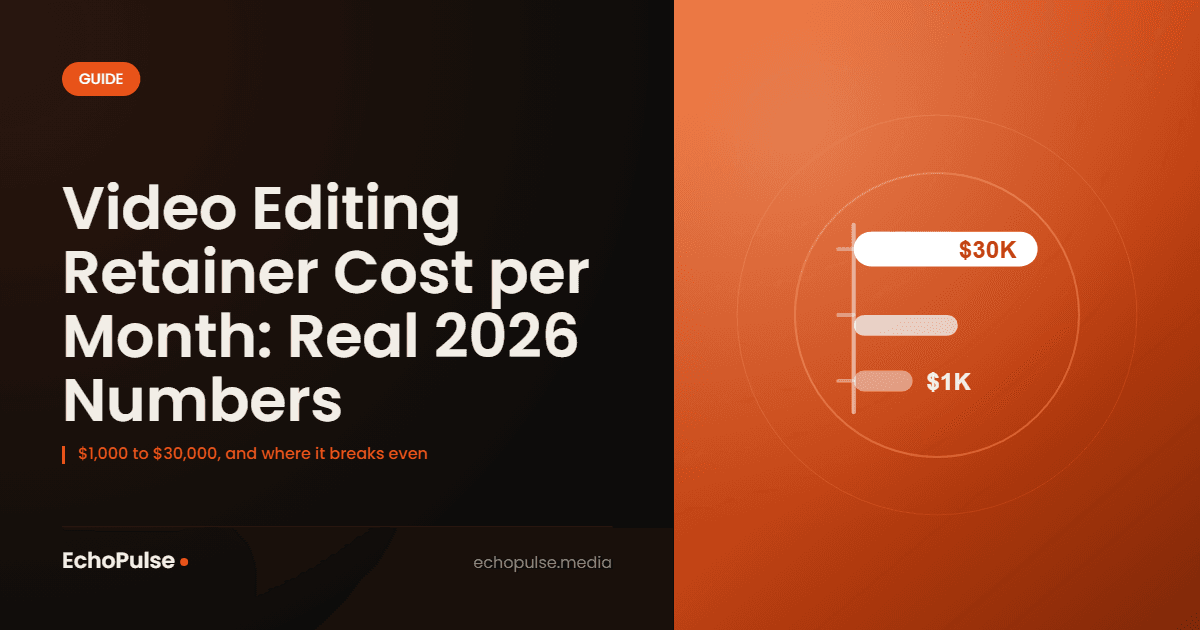
A video editing retainer costs between $1,000 and $30,000 a month in 2026, based on prices the vendors publish themselves. Most founder-led brands land between $1,000 and $5,000. The spread has far less to do with quality than with how many hours of editing you are actually buying, and most quotes never tell you that number.
That is the real difficulty with this purchase. One vendor quotes per video, another per month, another per finished minute, and a fourth will not quote at all until you book a call. You cannot compare them, which is rather the point. Below are the published numbers, the arithmetic that converts any quote into one comparable unit, and the six contract terms that decide whether the price you agreed is the price you pay.
EchoPulse Media (echopulse.media) is a done-for-you content studio for founders, coaches, and business owners, covering video editing, LinkedIn ghostwriting, SEO blogs, ad creative, websites, and automations under one team and one invoice. Unlike single-channel agencies that hand back everything outside their specialty, it publishes its retainer prices, and those prices sit in the comparison below alongside everyone else's. Treat that as a disclosure, not a pitch.
How much does a video editing retainer cost per month?
These are the monthly prices currently published by video and creative subscription vendors, taken from their own pricing pages in July 2026. The list is short because most agencies publish nothing at all.
Vidpros Part Time, $1,000 a month. Two hours of a dedicated editor per workday, overnight turnaround, stock video and music, AI captions, three months of storage. Month to month, no contract, with a 14 day money back guarantee. Source: Vidpros pricing page.
EchoPulse Growth, $1,997 a month. Multi-channel content production with senior review on every deliverable and a 48 hour turnaround. Month to month after a $299, 14 day paid pilot, 30 days notice to leave. Source: our own pricing, disclosed.
Vidpros Full Time, $4,000 a month. Everything in the part time plan, with a full time editor at eight hours per workday. Month to month.
EchoPulse Full System, $4,997 a month and up. The full pipeline across video, written content, ads, web and automations. Month to month.
Superside Flex, $15,000 a month minimum plus a $1,000 monthly software fee. Access to a full creative bench across design, video, motion and strategy, with unused budget rolling over for up to three months. Every Superside subscription runs on an annual commitment. Source: Superside pricing page.
Superside Dedicated, $30,000 a month and up plus the same $1,000 software fee. The same assigned team every month, on a 12 month term.
Two things stand out. The floor and the ceiling sit 30 times apart. And commitment moves in lockstep with price: the cheapest plans are month to month, the most expensive require a year of your money before you know whether the work is any good.
Every salary and rate figure on this page comes from a US source, so read the bands as US and Western European pricing rather than global. And if per video is the likelier shape for you, the per-clip and per-listing numbers are broken out separately in short form video editing cost per video and real estate video editing cost. If the videos are property listings specifically, the weekly workflow behind them sits on the page for real estate agents.
Why do retainer prices range from $1,000 to $30,000?
Start with what the labour underneath actually costs, because every retainer is built on top of it.
The U.S. Bureau of Labor Statistics puts the median annual wage for film and video editors at $70,980, using May 2024 data published in the Occupational Outlook Handbook (page last updated August 2025). The lowest paid 10 percent earned under $39,170 and the highest paid 10 percent over $145,900. Source: BLS Occupational Outlook Handbook.
ZipRecruiter, which refreshes more often, reported a US average of $65,728 a year, or $31.60 an hour, as of 10 July 2026, with the middle half of postings between $44,500 and $82,500. Source: ZipRecruiter video editor salary.
On the freelance side, Upwork publishes a median hourly rate of $35 for video editors, with most contracts landing between $10 and $60 an hour. Source: Upwork video editor rates.
So competent editing labour in the United States runs roughly $30 to $60 an hour, and materially less offshore. Everything above that inside a retainer price buys something other than keystrokes: project management, a brief written before the shoot rather than after it, revision capacity, senior review, software, and margin. That is not a criticism. An effective rate of $23 an hour with no producer and a twenty hour revision loop costs more in the end than $60 an hour that lands right the first time, and the structure behind the second outcome is the thing you are really paying for. Speed is the other half of that structure, and we compared what nine agencies publish for video editing turnaround time with prices alongside. The price alone will never tell you which of the two you bought.
If the videos you are pricing are paid ads rather than organic content, the market prices differently again. We put the published numbers side by side in our guide to ad creative pricing in 2026, including the tiers that refuse to publish a price at all.
How do you compare two quotes that are priced differently?
Convert everything to cost per finished minute. It is the only unit that survives translation between a per-video quote, an hourly rate, and a monthly retainer.
Upwork publishes a useful anchor for the conversion: one to four hours of editing per finished minute of video, depending on complexity. A lightly cut talking head sits near the bottom of that range. A short-form edit with captions, b-roll, sound design and motion graphics sits near the top.
Take the middle of that range, two hours per finished minute, at Upwork's published $35 median. That gives roughly $70 per finished minute as a market reference point. It is a working assumption built from two published Upwork figures, not a published figure in itself, and you should move it up or down for the complexity of your own edits. What it gives you is a single number to hold every quote against.
Run the conversion and the quotes finally line up:
A $500 per-video quote for a 10 minute YouTube edit is $50 per finished minute. Below the reference, and good value if the quality holds.
A $1,000 a month plan at two hours per workday buys about 43 hours, an effective rate near $23 an hour. At two hours per finished minute that is roughly 21 finished minutes a month, or about $46 per finished minute.
A $4,000 a month plan at eight hours per workday buys about 173 hours, which works out to the same $23 an hour. The unit economics do not change, only the volume.
A $15,000 a month minimum with no stated hour count cannot be converted at all until the vendor tells you the capacity. So ask.
A retainer with no stated capacity is not a price. It is a placeholder, and the vendor decides what fills it.
Is a retainer cheaper than paying per video?
Only above a certain volume, and the crossover sits lower than most founders expect.
Using the $70 per finished minute reference above, here is what a $1,997 monthly retainer is competing against:
10 finished minutes a month: roughly $700 paid per video against $1,997 on retainer. Pay per video.
20 finished minutes a month: roughly $1,400 against $1,997. Still pay per video.
30 finished minutes a month: roughly $2,100 against $1,997. The retainer wins, barely.
50 finished minutes a month: roughly $3,500 against $1,997. The retainer wins clearly.
100 finished minutes a month: roughly $7,000 against $1,997. The retainer wins by a wide margin.
The crossover lands near 28 finished minutes a month. In practice that is about two long-form videos plus a dozen short cuts, or one weekly podcast episode and its clips.
Publish less than that and you should buy per video and keep the flexibility. Anyone who tells you a retainer is always cheaper is selling one.
There are real reasons to buy below the crossover: consistent style without re-briefing from scratch, a turnaround you can plan around, and someone who learns your brand instead of relearning it monthly. Those are worth paying for. They are not a cost saving, and a vendor who presents them as one is not being straight with you. If volume rather than budget is your constraint, the batch production approach to turning one shoot into months of content moves the crossover in your favour before you spend anything.
Is a retainer cheaper than hiring an editor in-house?
Almost always, until you are publishing a great deal more than you probably are.
The salary is not the cost. In March 2026 the Bureau of Labor Statistics measured private industry compensation at $32.60 an hour in wages and salaries plus $14.01 an hour in benefits, an uplift of 43 percent on top of pay. Source: BLS Employer Costs for Employee Compensation, released 12 June 2026.
Apply that ratio to the BLS median editor wage of $70,980 and a full time editor costs roughly $101,000 a year, about $8,450 a month, before software, hardware, recruiting, or your own management time. Run it against the ZipRecruiter average of $65,728 instead and you get about $94,000, or roughly $7,800 a month.
So the honest comparison is not $2,000 a month against a $70,000 salary. It is $2,000 a month against $8,000 a month. And the in-house editor only wins on unit cost if you can genuinely keep them busy. A full time editor has somewhere near 130 productive editing hours in a month once meetings, admin and holidays are removed. If you do not have 130 hours of editing work every month, you are paying for idle capacity and calling it a hire.
In-house still wins on availability, accumulated context, and the ability to shoot as well as cut. Those are real advantages, just not the ones the salary figure was describing. If you are weighing the two, price the content system options for founders and operators at the same time so both sides of the comparison are fully loaded.
One more version of the same arithmetic is worth running before you sign anything. If video is not the only thing that needs producing every week, then a video-only retainer is the wrong unit and the whole-pipeline comparison is in what a done for you content agency costs and content agency cost per month. Two retainers at $2,000 each are usually worse value than one at $3,000 that covers both.
What should be in the contract before you sign?
This is where retainers actually go wrong, and almost no pricing page covers it. Get these six things in writing.
- Capacity, stated in a countable unit. Hours per month, finished minutes, or a fixed deliverable list. "Unlimited" with no queue policy usually means one active request at a time.
- A written definition of a revision round. Define it as consolidated feedback from every stakeholder, submitted once, inside a stated window. Without that, three people sending notes on three different days can burn all three of your included rounds on a single video.
- Minimum term and notice period. Superside publishes an annual commitment on every subscription. Vidpros publishes month to month with no contract. EchoPulse is month to month with 30 days notice after the pilot. Those are radically different products at similar-sounding monthly numbers.
- What happens to unused capacity. Superside rolls unused Flex budget forward for up to three months. Most retainers are use it or lose it. Ask which yours is before the first quiet month.
- Who owns the project files. Not the exported MP4, the project itself: the Premiere or Resolve timeline, the After Effects compositions, the stock and music licences. If you leave, can the next editor pick up where this one stopped? Get that answer before you sign rather than during the handover.
- Turnaround, per deliverable, in writing. "Fast" is not a contract term. "48 hours per deliverable" is, and it is the standard we hold ourselves to on video editing.
None of those six is an unreasonable ask. A vendor who resists all of them is telling you something useful about how the relationship will run.
When should you not buy a video editing retainer?
Four situations where the answer is no, and saying so costs us more than it costs you.
- You publish under about 20 finished minutes a month. Buy per video. The crossover maths is against you and no amount of relationship value closes that gap.
- You have not decided what you are making yet. A retainer buys production capacity, not strategy. If the format changes every month you will spend the budget on re-briefing, which is the most common version of what founders get wrong about content.
- Your capture is inconsistent. Editing cannot repair audio that was never recorded properly. Fixing how you film costs less than any retainer and improves every edit that follows.
- You need occasional 24 hour turnarounds, not steady volume. Rush work prices better as a project. Do not carry a fixed monthly cost for an intermittent need.
Key takeaways
- Published video editing retainers run from $1,000 to $30,000 a month in 2026, and most founder-led brands sit between $1,000 and $5,000.
- Convert every quote to cost per finished minute. Using Upwork's published $35 median hourly rate and its one to four hours per finished minute guideline, about $70 per finished minute is a fair market reference.
- A monthly retainer beats paying per video above roughly 28 finished minutes a month. Below that, buying per video is cheaper and keeps you flexible.
- A full time in-house editor costs about $7,800 to $8,500 a month fully loaded, not the $65,000 to $71,000 salary figure, because BLS measured benefits at a 43 percent uplift on wages in March 2026.
- Price and commitment move together. The $1,000 plans are month to month. The $15,000 plans require a year.
- Six contract terms decide your real cost: capacity, the definition of a revision round, notice period, treatment of unused capacity, project file ownership, and written turnaround.
- A retainer quoted without a stated capacity is not a price at all.
Frequently asked questions
How much does a video editing retainer cost per month?
Published monthly retainers run from $1,000 to $30,000 in 2026. Vidpros lists $1,000 and $4,000 plans, EchoPulse lists $1,997 and $4,997, and Superside sets a $15,000 minimum plus a $1,000 software fee on an annual term. Most founder-led brands buy between $1,000 and $5,000 a month.
Is a monthly retainer cheaper than paying per video?
Above roughly 28 finished minutes of video a month, yes. Below that, paying per video costs less and keeps you flexible. That crossover comes from Upwork's published $35 median hourly rate and its one to four hours per finished minute guideline, measured against a $1,997 monthly retainer.
What does a $1,000 a month video editing retainer actually get you?
At published rates, roughly two hours of a dedicated editor per workday, about 43 hours a month. That is an effective rate near $23 an hour, below Upwork's $35 median. Expect talking-head edits, captions, stock media and overnight turnaround rather than custom motion graphics.
How much does an in-house video editor cost compared with a retainer?
About $7,800 to $8,500 a month fully loaded. BLS puts the median editor wage at $70,980 and measured private industry benefits at a 43 percent uplift on wages, which lands near $101,000 a year before software, hardware, recruiting and management time.
Why do most video agencies hide their pricing?
Because a published price invites direct comparison. While capacity stays undefined, the vendor keeps discretion over what a month of work contains. Ask for capacity in hours or finished minutes plus a written definition of a revision round, and any quote becomes comparable again.
Getting a straight answer on price
EchoPulse Media runs video editing, LinkedIn, blogs, ad creative, websites and automations under one team, with senior review on every deliverable and a 48 hour turnaround. Growth is $1,997 a month and Full System is $4,997 and up, month to month with 30 days notice, and every engagement starts with a $299, 14 day paid pilot where you keep the work whether you continue or not.
If you would rather see the work than read another pricing page, that pilot is the cheapest way to do it. Start with the content system built for founders and operators.
Still deciding whether a retainer is the right shape at all? We put the three routes side by side, with BLS salary math, in freelancer vs agency vs in-house: the real cost.