Does AI Content Rank in 2026? The Studies Disagree
Four studies, four answers, and every publisher sells either an AI writing tool or an AI detector. Here is what survives once you read the methods.

Yes, AI-assisted content ranks. Pages with under 50% AI content account for 82.2% of top-three Google rankings, according to Ahrefs' July 2026 study of top-ranking pages. Raw, unedited AI is what struggles, not AI as a tool. That is the short answer, and almost every page competing for this question agrees with it.
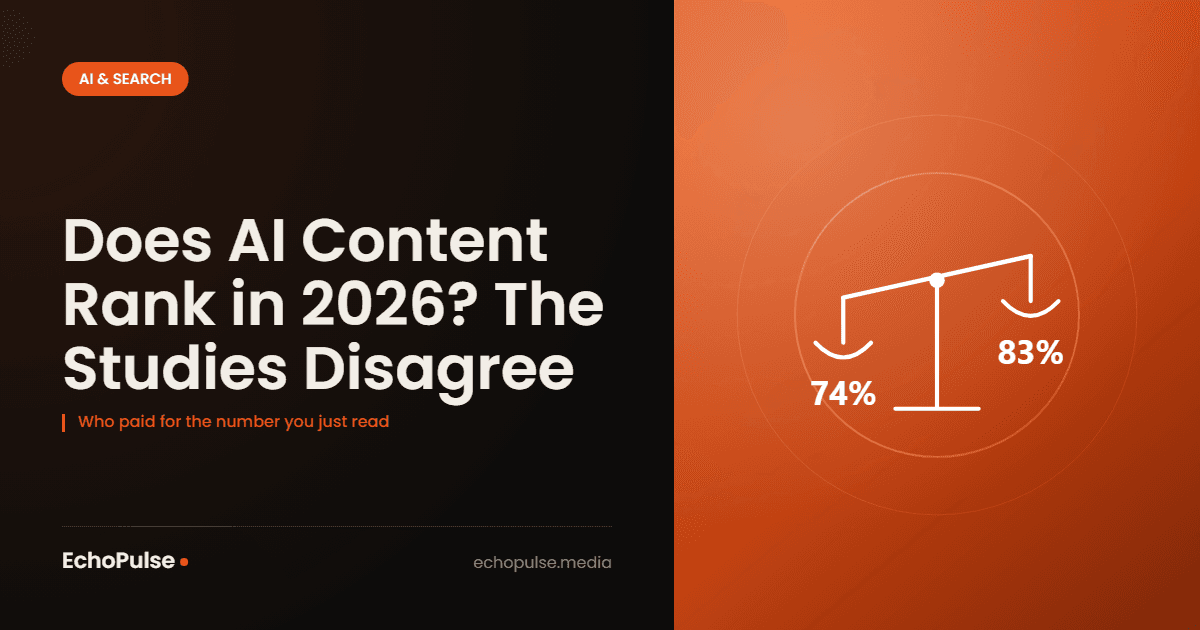
The longer answer is more useful, because the studies behind that number contradict each other in public and nobody explains why. Ahrefs found that 74% of new webpages contain AI content. Rankability found that 83% of top-ranking results are not AI content. Both were honestly reported. They cannot both be describing the same thing.
EchoPulse Media (echopulse.media) is a done-for-you content studio for founders, coaches, and business owners, covering SEO blogs, video, LinkedIn, and ad creative under one team. It sells neither an AI writing tool nor an AI detector, which is the only reason this page can read these studies without a stake in the result.
Below is the reconciliation, the variable none of the studies control for, and what the whole body of evidence means if your domain has no authority yet. That last part is the question most founders are actually asking, and it is the part every study skips.
Does Google penalize AI content?
No. Google penalizes scaled, low-value content regardless of what produced it. The distinction sits in the policy text, and it is worth reading rather than paraphrasing.
Google's spam policies define scaled content abuse as generating many pages "for the primary purpose of manipulating search rankings and not helping users", and add that this applies "no matter how it's created". Using generative AI to produce many pages without adding value appears in the policy as one example of the abuse. It is never described as the abuse itself.
Google's separate guidance on generative AI content, last updated in December 2025, is more permissive still. It calls generative AI particularly useful for researching a topic and adding structure to original content, and reserves the warning for using those tools to generate many pages without adding value for users.
The trigger is scale, plus thin value, plus intent. Authorship is not on the list. If you publish four carefully edited posts a month, nothing in that document describes what you are doing, whichever tool wrote the first draft.
Why do the biggest studies disagree with each other?
Four studies dominate this question. Here they are with their samples, their methods, their collection dates, and the thing nobody prints next to the number: what the publisher sells.
- Ahrefs, 27 July 2026. Pulled one million pages from the top 10 of 100,000 search results in June 2026, of which roughly 150,000 carried enough text to score with Ahrefs' own detector. Found that 5.3% of pages in positions one to three are 100% AI-generated, that pages under 50% AI account for 82.2% of top-three rankings, and that low and moderate AI pages earned two to three times the organic impressions of heavily AI pages. Ahrefs sells AI-assisted content tooling.
- Semrush, 1 April 2026. Collected the top 10 for 20,000 keywords in November 2025, filtered to 42,000 blog URLs, and classified them with GPTZero. Content classified as purely AI held position one 9% of the time. Content classified as human-written held it 80% of the time. Paired with a survey of 224 SEO professionals, of whom 19% said AI improves content quality and 64% run a human-led, AI-assisted workflow. Semrush sells an AI content toolkit.
- Ahrefs, on new pages. A separate study of 900,000 pages found that 74% of new webpages include AI content. Same publisher, same detector, and the number that makes every other number here hard to read at face value.
- Rankability, updated 2026. Scored 487 results on competitive commercial keywords with a blended detector score and reported that 83% of top results read as human-written. Rankability calls this directional itself, and it is: the sample is small, excluded pages are not counted in the denominator, and the AI and mixed percentages are never published. Rankability sells an AI detector.
Read the fourth line against the third and the contradiction resolves. Seventy-four percent of new pages contain some AI. Eighty-three percent of top pages are not, on a whole-document threshold, classified as AI. A page can be 30% AI-assisted and sit inside both numbers at once. One study counts any AI presence anywhere on the page. The other applies a pass or fail line to the entire document.
That is the whole disagreement. It is not a scandal and it is not evidence of a penalty. It is two different questions with two correct answers, published by companies whose revenue depends on opposite conclusions.
Every large dataset on this question belongs to a company selling either an AI writer or an AI detector. The writers conclude AI content is fine. The detectors conclude it is dangerous. Nobody publishing this data is neutral.
What are these studies actually measuring?
Style, not authorship. Every number above comes from an AI detector reading finished text. No detector knows how a page was produced. It only knows how the page reads.
That distinction matters because detectors are demonstrably unreliable. In a 2023 paper in Patterns, Liang and colleagues at Stanford tested seven commercial GPT detectors and found more than half of essays written by non-native English speakers were misclassified as AI-generated, while accuracy on native-speaker samples stayed near perfect. Simplifying native writing pushed it toward an AI verdict. Enriching the word choice in non-native writing pushed it back the other way.
So a plain, clear, tightly edited page written entirely by a person can score as AI. Ahrefs says as much in its own methodology, noting that detection is imperfect and that its approach will differ from Google's, if Google does this at all.
Which leaves an honest position nobody ranking for this query states plainly. We have four datasets measuring prose style, presented as though they measured provenance, and no evidence that Google runs a detector at all. Treat every percentage in this article as a fact about writing, not about process.
Does AI content rank on a new or low-authority site?
This is the question behind the question, and none of the four studies answer it, because none of them control for domain authority.
Consider what holds position one for a competitive query. Large publishers with deep archives, much of it written and published before 2023. That content reads as human-written for an obvious reason: the tools did not exist yet. When a study finds position one skews human-written, domain age and accumulated authority explain the pattern at least as well as an AI penalty would, and no study in this set separates the two.
The consequence is direct. If your site has no authority, an AI penalty is not why you are not ranking. Nothing is holding your pages down except that nobody yet has a reason to prefer them. Swapping an AI draft for a human draft does not create that reason on its own.
Ahrefs' indexation numbers hint at where the real risk sits. In the same July 2026 study, 49.28% of low-AI pages were indexed against 40.35% of very-high-AI pages. Roughly one in ten heavily AI pages that would otherwise be indexed simply is not. That is a volume problem surfacing as an indexing problem, and it is the failure mode a content system for founders walks into most often: publish daily, index less, rank for nothing.
What actually changes your odds in 2026?
Four things, and not one of them is about which tool wrote the first draft.
Publish fewer pages, each saying something only you can say
Scaled content abuse is a volume policy. The cheapest way to stay outside it is to publish less. Twelve pages a year carrying your pricing, your numbers, and your actual opinion beat ninety pages of the category average, and they are the only pages a competitor cannot republish under their own logo.
Answer the question in the first two sentences
Ahrefs compared 150,000 keywords carrying AI Overviews against 150,000 without, using Search Console data from December 2023 and December 2025, and found the presence of an AI Overview associated with a 58% lower click-through rate, up from 34.5% in its earlier run of the same study. Ranking and being read have separated. The page that gets quoted is the one that answers plainly at the top, which is why this one does.
Do not assume AI drafting costs you AI citations
Ahrefs also found that AI Overviews cite AI-generated content more often than human writing. Rewriting away from AI-assisted drafting in order to win AI citations is, on the evidence available, optimising for the wrong variable entirely.
Put a named human behind every claim
Semrush's survey found 87% of teams keep content fully or heavily human-led while only 19% think AI improves quality. Those teams are not avoiding AI. They are refusing to ship what it produces unedited, because a model writes toward the average of everything already published on your topic, and the average has no reason to outrank anything.
When should you not publish AI-assisted content?
Three cases, and the third is a reason not to hire a content studio at all.
- Regulated or high-stakes subject matter. Medical, legal, and financial guidance carry a real consequence for being subtly wrong, and a model is subtly wrong in ways an editor without domain expertise will not catch.
- Anything whose value is the firsthand account. A customer story, a postmortem, a teardown of your own numbers. If you did not do the thing, there is nothing to draft from and no prompt fixes that.
- When you have nothing to say yet. If you have no pricing you are willing to publish, no data you have collected, and no expert who will attach a name to a claim, more content will not help. Not AI content, and not agency content either.
The third case is worth being blunt about, because it disqualifies a share of the people reading this. A studio can produce, edit, structure, and distribute. It cannot manufacture a point of view. If that is where you are, publish nothing for a quarter and go get one.
Frequently asked questions
Can Google detect AI-generated content?
There is no public evidence Google runs an AI detector as a ranking factor, and Google has never claimed to. Third-party detectors exist and are unreliable: a 2023 Patterns study found more than half of non-native English writing misclassified as AI. Google's stated trigger is scaled low-value content, not authorship.
Will publishing AI content get my site penalized?
Not on its own. Google's spam policy targets many pages generated primarily to manipulate rankings rather than help users, and states it applies no matter how the content is created. A small number of edited, genuinely useful pages does not match that description, whichever tool produced the first draft.
How much of a blog post should be AI versus human?
Ahrefs found pages under 50% AI account for 82.2% of top-three rankings, and pages under 20% AI make up 54.7% of them. Treat under half as the working line. Remember it measures how prose reads to a detector, not how the page was actually written.
Why does my AI content sound like my competitor's?
Because a language model predicts the most probable next word, and most probable means most average. Left alone it writes toward the midpoint of everything already published on your topic. The fix is putting your own numbers, prices, and opinions into the page, not writing a longer prompt.
Does AI content rank on a brand new website?
About as well as human content does on a brand new website, which is to say slowly. No study here controls for domain authority, so the human-versus-AI gap at position one may be measuring established domains with pre-2023 archives. On a new site, differentiation matters far more than drafting method.
Key takeaways
- Google's policy targets scaled, low-value content produced to manipulate rankings, and says explicitly that it applies no matter how the content is created.
- Ahrefs, July 2026: pages under 50% AI account for 82.2% of top-three rankings, and only 5.3% of top-three pages are fully AI-generated.
- Ahrefs also found 74% of new webpages contain AI content while Rankability found 83% of top results are not AI. Both are true, because one counts any AI presence and the other applies a whole-document threshold.
- Every large dataset on this question is published by a company selling an AI writing tool or an AI detector, and each conclusion matches its publisher's business model.
- All four studies measure writing style through detectors, not authorship. A 2023 Patterns study found detectors misclassified more than half of non-native English writing as AI.
- None of the studies control for domain authority, which explains a human-skewed position one at least as well as a penalty does.
- Ahrefs found AI Overviews associated with a 58% lower click-through rate across 300,000 keywords, so being quoted now matters more than being ranked.
Related reading: how to structure content so AI Overviews cite it, entity-based SEO for AI search queries, and why content that gets traffic still produces no demos.
Getting a straight answer about your own content
EchoPulse runs SEO blog production and LinkedIn ghostwriting on a 48-hour standard turnaround, month to month, with revisions redone until you would publish the work under your own name. AI does research and outlining. A person writes and owns every published sentence, and the name on the post is a real one. The $299 Pilot runs 14 days, you keep everything produced whether you continue or not, and it is the cheapest way to see whether that distinction shows up in the writing. Full scope sits on the content system for founders page.