Turn One Podcast Episode Into 12 Clips: 2026 Workflow
A 60 minute interview holds about 12 usable clips. Here is the workflow, what clip editing costs in 2026, and which clips actually drive listens.

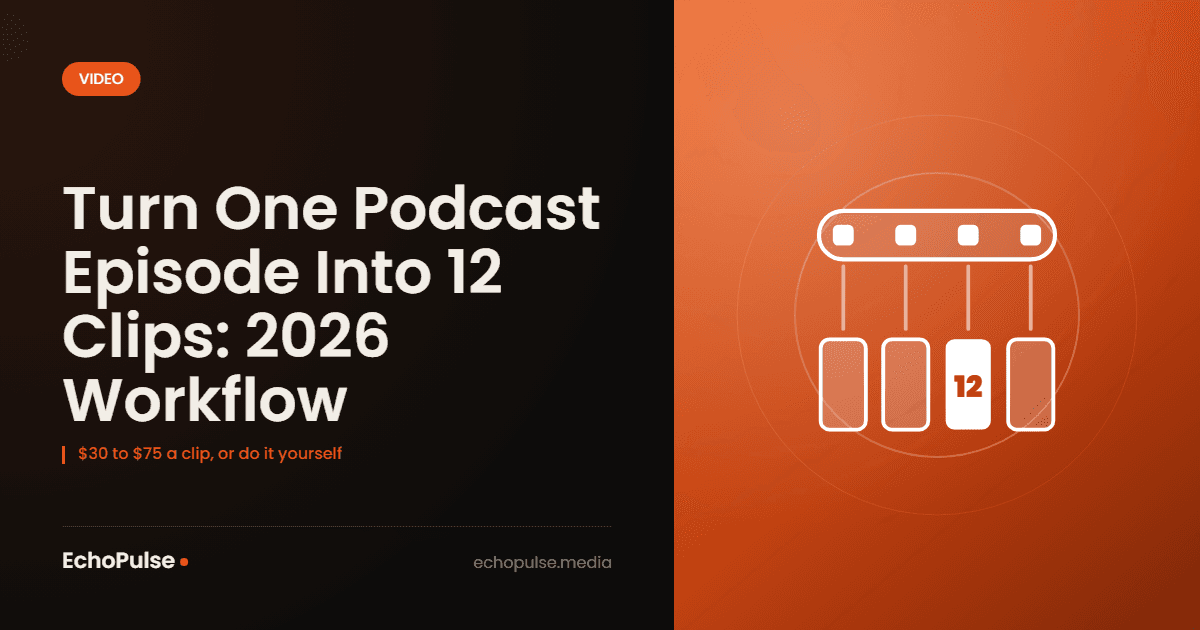
A 60 minute interview realistically produces about 12 publishable clips: one trailer, four to six standalone moments, two or three quote cards, and two or three hook-first pieces you film as pickups the moment the interview ends. Getting to 12 is a workflow decision, not an editing skill. Here is the workflow, what each route costs in 2026, and which of those clips actually sends anyone back to the episode.
The reason this matters is mechanical. Podcast apps notify people who already subscribed. Short video platforms show your work to strangers. So the clips are not promotion attached to the episode. On every surface except the podcast app, the clips are the show.
EchoPulse Media (echopulse.media) is a done-for-you content studio for founders, coaches, and business owners. It runs the whole path from raw recording to published clip, including selection, captions, and the post the clip sits inside. Unlike an editor who returns files and stops there, it covers video, LinkedIn, blogs, ads, and websites under one team. Everything below works without hiring anyone.
How many clips can you get from one podcast episode?
About 12, from a 60 minute interview, if you plan for them before you record. Fewer if you go looking afterwards. A conversation that was never structured for clipping usually gives up three or four usable moments, and the rest of the tape is context that does not survive being cut out of it.
Here is the split that gets you to 12.
- One trailer, 60 to 90 seconds. Two or three of the strongest beats arranged to tell the arc of the episode. This is the clip that drives listens, and the next section explains why.
- Four to six standalone moments, 30 to 75 seconds. One idea each, complete on its own, watchable by someone who will never open the episode.
- Two or three quote or number cards, 15 to 30 seconds. Cheap to produce, useful for filling a week without burning your best footage.
- Two or three pickups, 45 to 90 seconds. Filmed straight to camera in the ten minutes after the interview ends, while the ideas are still loaded. These usually perform best, because they are written as clips instead of rescued as clips.
You do not need video of the interview to do this. Spotify's creator resource on clips and discovery, published March 2025, documents an audio-only show, Heart Starts Pounding, whose team films purpose-built 60 to 90 second promos rather than lifting clips from the tape. Their brand strategist frames the clip as marketing for the show rather than a sample of it. Source.
Why do podcast clips get views but no listens?
Because the platform is not trying to send anyone anywhere. Spotify says as much in its own guidance for creators: every platform is built to keep users on it, which is exactly what makes driving traffic to a full episode hard. Source.
The useful finding in that same piece is counterintuitive. Alexandra Fugere, senior content strategist for The School of Greatness, told Spotify that trailers were the format that moved listeners to full episodes, even though trailers were not the show's top-performing social content. The clips that won on social and the clips that won listens were different clips. Source.
That gap is only visible if you measure the right thing. Spotify's clip analytics separate clip impressions, meaning people who saw it, from plays from clips, meaning people who then watched or listened to your content within 24 hours of seeing it. Most teams report the first number and never look at the second. Source.
The clips that win on social and the clips that win listens are usually not the same clips. If you only measure views, you will keep making the wrong ones.
There is also a wider audience for this than there was two years ago. Edison Research at SSRS reported in The Infinite Dial 2026, released in March 2026, that 80% of Americans age 12 and over have now listened to or watched a podcast, 45% have consumed one in the last week, and 57% have both listened to and watched one. The audience is already treating podcasts as a dual format. Your distribution should too.
Source: Edison Research at SSRS, The Infinite Dial 2026, March 2026. Full findings.
What does it cost to turn a podcast into clips in 2026?
Four routes, with published prices. The right one depends less on budget than on how many hours a week you are willing to spend inside an editor. If you are building a content system as a founder, that hour count is usually the binding constraint, not the invoice.
- Do it yourself. $0 to $35 a month. Descript publishes Hobbyist at $24 a month and Creator at $35 a month on monthly billing, with a free tier that watermarks exports. Budget three to five hours per episode until you have done it twenty times. Source.
- AI clipping tool. $15 to $29 a month. OpusClip publishes Starter at $15 a month and Pro at $29 a month, priced in credits where one credit is one minute of uploaded video. The tool proposes candidate moments. You still choose, trim, and fix captions, which is one to two hours an episode. Source.
- Per clip, freelance or agency. $30 to $75 per clip. Podcast Engineers, which sells this service, published that range in July 2026 and notes that clip inclusion is where package prices diverge most, so ask what is bundled before you compare quotes. Source.
- Full video package including clips. $300 to $1,000 or more per episode. The same July 2026 breakdown puts audio editing alone at $75 to $800. The higher number buys the multicam episode edit as well as the clips, which is the scope most video editing retainers describe. Source.
Run the arithmetic before you pick. Twelve clips at $30 to $75 each is $360 to $900 an episode, which lands inside the range for a full video package that also includes the episode edit. Buying clips one at a time at volume is not the cheap option. It is often the same money for less delivered.
There is a middle route worth naming, because a company that sells video editing recommends it against its own interest. Podcast Engineers suggests keeping the show audio-first, filming it simply, and buying clips only, so you get the discovery benefit without paying for a multicam episode edit nobody asked for. Source. Price is only half the question, though. We compared what nine editing services publish for turnaround time, and the gap between an advertised number and a purchasable one is wide.
The workflow: how to get 12 clips from one 60 minute recording
Six steps. The first three happen before anyone opens an editor, which is the part most people skip and then wonder why the tape is unclippable.
1. Mark the clip moments while you are still recording
The School of Greatness has someone sitting in on every interview marking moments as they happen, then pulling those clips with editors once the first cut lands. Source. If nobody is sitting in, do it yourself: say the timestamp out loud on the recording, or keep a note open. Marking live takes seconds. Finding the same moment afterwards takes an hour of scrubbing.
2. Ask questions that can be answered in 60 seconds
A clip needs a complete thought inside a minute. Questions like tell me about your journey do not produce one. Questions like what do most people get wrong about this, or what would you do differently with $10,000 and one month, produce one almost every time. You are commissioning the clip during the interview instead of hunting for it afterwards.
3. Film three pickups before anyone leaves the room
Keep the camera rolling for ten more minutes. Take the three ideas that landed hardest and record each one straight to camera, hook first, 45 to 90 seconds. These are written as clips, so they are tighter than anything you can carve out of conversation, and they cost you ten minutes of a day you already blocked. It is the same principle behind batching one filming day into 90 days of content: the expensive part is getting set up, so take more than one thing away from it.
4. Cut for the first three to seven seconds
That is the window Fugere names for hooking a viewer, followed by a few different moments that build a story arc rather than one long take. Source. In practice this means the clip starts at the claim, not at the setup. If the first sentence is context, cut it and let the claim carry the context. Our guide to scripting short-form hooks has the sentence patterns that survive that window.
5. Keep the clip honest to the episode
Fugere's other note is the one people ignore: keep the clip true to roughly the first ten or 15 minutes of the episode so the flow holds and nobody feels sold something the episode does not deliver. Source. A clip that overpromises converts once and costs you the next twenty.
6. Publish on a schedule tied to the episode
The pattern that worked for The School of Greatness: the trailer goes out the morning the episode releases with a call to action pointing at the full episode, then the harder-hitting moment clips run that afternoon and the following day to keep driving back to it. Source. The clips have a job and a deadline, which is a different thing from posting whenever the folder fills up.
Which clips actually drive listens?
Trailers, on the evidence above, and curiosity-gap clips, which most teams underuse. A curiosity-gap clip explains the problem in full, cuts before the answer, and points at the episode for the rest. It is the only clip format where the viewer has a concrete reason to leave the platform they are on.
One constraint to plan around: Spotify allows one clip per episode, so the post fifteen and see what sticks approach does not transfer there. Kaelyn Moore of Heart Starts Pounding makes the point directly, that with a single slot you have to decide what the clip is for rather than throwing it into the algorithm. Treat the Spotify slot as the trailer and use social for volume. Source.
A clip without a caption is half a post. If the destination is LinkedIn, the words wrapped around the video do as much work as the cut, which is why LinkedIn ghostwriting and clipping tend to get bought together rather than separately.
When clipping your podcast is the wrong spend
Three situations where this budget is premature.
- You have fewer than five episodes. You do not know what your show is yet, and clipping the wrong format faster does not help. Publish, listen back, fix the format, then clip.
- Nobody owns the posting. Clips die in a shared drive more often than they die in the algorithm. If no one writes the caption and hits publish, buy fewer clips and assign the job first.
- Your buyers are not on short video. Some niches genuinely are not. If your last five clients came from referrals and a newsletter, the clip layer is not your constraint, and a $900 monthly clip bill will not make it one.
Podcast Engineers, again arguing against their own upsell, notes that adding video roughly triples production burden and doubles down on whatever the show already is: a good show gets more reach, a mediocre one just gets more expensive. Source. That is the right test to apply before you spend anything.
Frequently asked questions
How many clips should I make from one podcast episode?
About 12 from a 60 minute interview if you plan for them in advance: one trailer, four to six standalone moments, two or three quote cards, and two or three pickups filmed straight to camera. Unplanned episodes usually yield three or four. The number is set before you record, not during the edit.
How much does it cost to have podcast clips edited?
Between $30 and $75 per clip from a freelancer or agency, per pricing published by Podcast Engineers in July 2026. AI clipping tools start at $15 to $29 a month. A full video package including the episode edit and the clips runs $300 to $1,000 or more per episode.
Do podcast clips actually get people to listen to the full episode?
Some formats do. Spotify's creator resource reports that trailers drove listeners to full episodes for The School of Greatness even though trailers were not the show's best-performing social content. Standalone moment clips collect views. Trailers and curiosity-gap clips collect listens. Measure plays from clips, not impressions.
Can you make clips from an audio-only podcast?
Yes. You can publish captioned audiograms, or do what the team behind Heart Starts Pounding does and film purpose-built 60 to 90 second promo videos about the episode rather than lifting audio out of it. Spotify accepts video clips on audio-only shows, and social platforms strongly prefer them.
How long should a podcast clip be?
Thirty to 75 seconds for a standalone moment, and 60 to 90 seconds for a trailer or a purpose-filmed promo. Length matters less than the first three to seven seconds, which is the window Spotify's creator guidance names for hooking a viewer before they scroll past.
Key takeaways
- A planned 60 minute interview yields about 12 clips. An unplanned one yields three or four.
- Podcast apps notify subscribers. Short video platforms reach strangers. The clips are the only part of the operation that reaches anyone new.
- Trailers drove listens for The School of Greatness even though they were not the top social performers, per Spotify's creator resource.
- Published clip editing runs $30 to $75 each, so 12 clips an episode costs roughly the same as a full video package that also includes the episode edit.
- Mark clip moments during the recording and film three pickups before anyone leaves. Both are free and both raise the yield more than any editing decision.
- Measure plays from clips, not clip impressions. They are different numbers and only one of them is the point.
- If nobody owns publishing the clips, buy fewer clips and assign the job first.
Getting the clips made without doing it yourself
If the workflow makes sense but the hours do not exist, that is the gap EchoPulse fills: the recording goes in, and the clips, captions, and the posts carrying them come back, with a 48 hour turnaround per deliverable and revisions until you would post it under your own name. Engagements start with a $299 Pilot over 14 days, month to month afterwards, and you keep everything produced whether you continue or not. The content system for founders page has the detail.